Showing posts with label wine. Show all posts

Monday, November 28, 2011

Banana Wine


The Ramble: Doesn't it sound so tropical? For a long time I knew that people made banana wine, and I had even read some banana wine recipes, but I didn't think I would like it. Then the more I thought about it, the more I needed to try it, and the better it sounded to me. Plus, I got five pounds of bananas for free! One of the coolest things about this recipe is that you chop up the banana skins to get out their natural tannins. They can be used in other wines too, but beware, they may leave a hint of banana on the nose!


Recipe:

4 lbs. peeled, chopped bananas (about 15-20 bananas)
juice of 2 lemons or 2 tsp. citric acid blend
1/4 to 1/2 lb. of chopped banana skins (4-5 skins)
1 gallon water
2 lbs. sugar
1 tsp. yeast nutrient
1/2 tsp pectic enzyme
white wine yeast (used K1V)

Peel bananas, chop bananas and skins, add to stock pot. Add water. Add lemon juice or acid blend. Bring to a boil, then simmer for 30 minutes. Let cool to room temp. This extracts tannins, sugars, flavor, and kills of wild yeasts. Add pectic enzyme, let sit overnight.

Next day, strain out the pulp/skins. Add sugar and nutrient, stirring well to make sure everything is dissolved. Add wine yeast, place in sanitized fermentor with an airlock, and voila!

This wine can take a long time to clear, just be patient. Bottle age for one year, if you can wait.

Enjoy.

Monday, November 21, 2011

Blueberry Wine

Introduction: This is a pretty clear cut, simple, and delicious recipe for a medium-to-full bodied blueberry wine. For a full-bodied wine, try 3 lbs of blueberries per gallon, for a lighter-bodied wine, try 2 lbs. Frozen berries will work. It is the most beautiful wine, too. Unbelievably purple.


Recipe:
2 1/2 lbs blueberries
boiling water to one gallon
2 lbs sugar (about 4 1/2 cups)
1/2 tsp. pectic enzyme
1 tsp. yeast nutrients
wine yeast (used montrachet)


Place blueberries in a stock pot, if frozen, allow to thaw. In another stock pot, boil about 1 gallon of water. Very carefully pour the hot water over the blueberries. This kills of wild yeasts. You can put in your sugar now, as it dissolves easier in hot water.

Let it all reach room temperature, then stir in your pectic enzyme. Let the mixture sit overnight. Add in your yeast nutrients and wine yeast.

After two days strain the must with cheese cloth, a nylon strainer bag, a turkey stuffing bag... whatever food safe device that works for you. Get all that juice out!

Put the juice in the fermentor with an airlock. Rack if/as necessary. Bottle when ready!

Enjoy it, it is delicious!

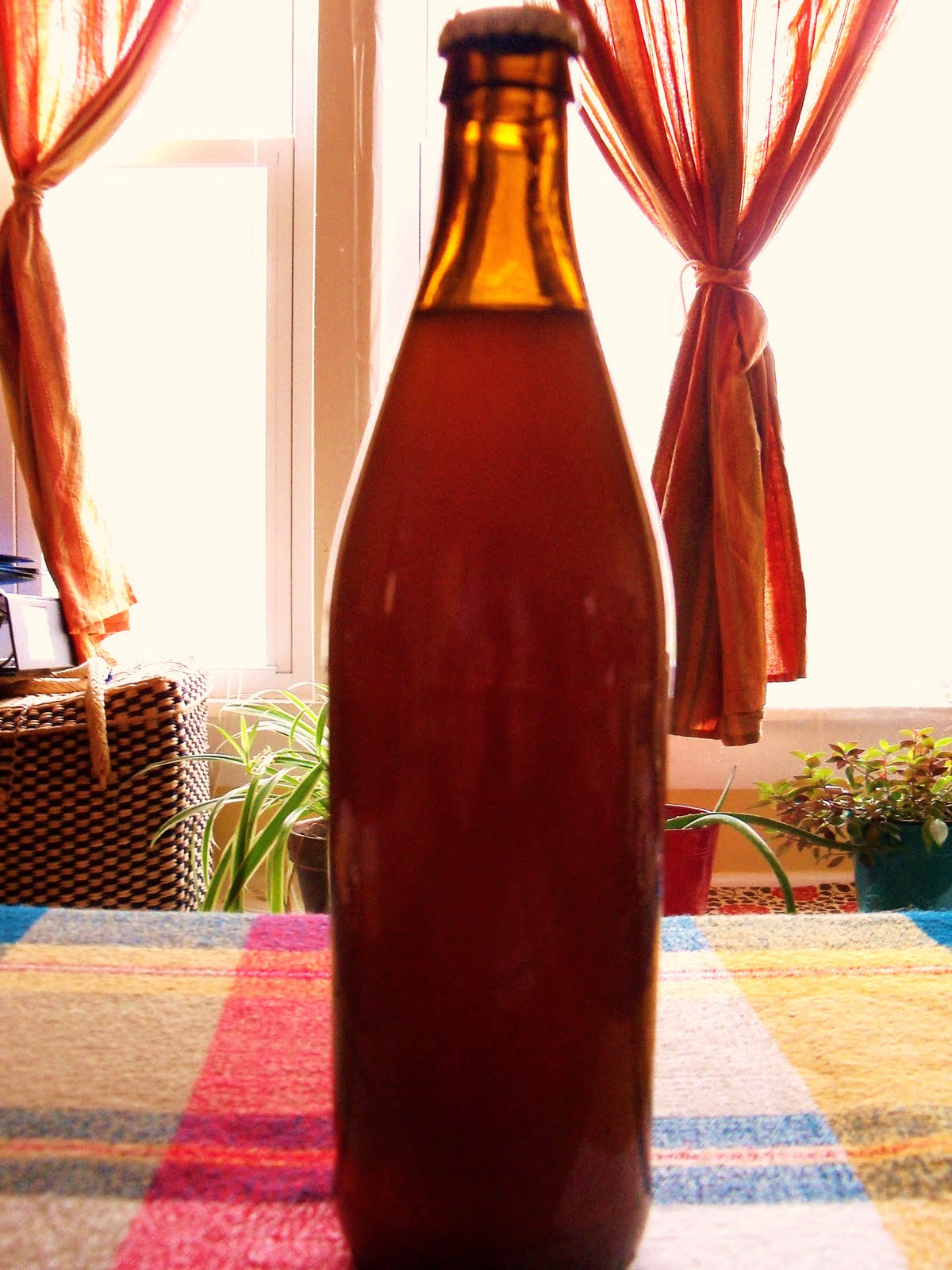
( photo on left: I had more juice than I could fit in my one gallon primary, so I threw it in a corona bottle with a balloon on top! Whatever it takes!)

The Winemaker

Tuesday, November 15, 2011

Pumpkin Ale

I made another beer. A while ago actually. Caity bought a kit for me from Midwest home brewing for my birthday, part grain part extract, for Pumpkin Ale. Just in time for Thanksgiving and Christmas... if it lasts that long.

So, here's the deal with these kits: they're a ton of fun, they have everything but the water, and they're super easy. Also, you don't need a ton of equipment--in fact, if you have what it takes to make a five gallon batch of wine, then you're pretty much set to make a five gallon batch of beer except, I suppose, for bottles, caps, and a capper, all of which are cheap, and bottles can be free if you've got a few friends willing to donate them to a good cause. I think that was a run-on sentence.

Anyway, with these kits, you basically crush up your grains with a rolling pin, put 'em in a boiling bag, and steep them in a few gallons of water for fifty minutes at about 150 degrees, like a big tea bag. Then you add in your malt extract and sugar, and bring it to a boil. Then you add in your hops, and let it keep boiling for about an hour. Then for the last five minutes, you add in some more hops--aroma hops. Then you cool it all down, put it in your bucket, fill it up to five gallons, pitch your yeast, and you're on your way to having beer! It takes more time than some wine... it takes less time than some wines, but what I like is that the payoff is so fast. You can be drinking your homemade beer in a month's time.
This beer is taking a little longer to clear for me, I made it back on October 3, my birthday. I'm making a guess and saying its because of the pumpkin juice having lots of pectin in it, but it tastes grand. A little hoppier than the Irish Red ale that I made not too far back. It's amazing that for less than 50 cents a bottle, you can make much, much, much better beer than you can buy in the store.

If you're a winemaker that appreciates beer, consider giving home brewing a try, the kits are a great way to start!

PS. I also just brewed a Belgian style wheat beer with orange peel and coriander the other day; I put the recipe together myself. I'll post it sometime in the next week or so, and hopefully you home brew buffs can check it out and give me some feedback!

Richard

Wednesday, November 2, 2011

Cranberry Wine

So here's the deal with this one. I'm fermenting it right now. Which means the recipe isn't necessarily tried and true by yours truly. I'm not in the habit of doing this. However, cranberry wine is coming very, very highly recommended from several individuals who are quite expert in the way of making country wines, and this recipe is a middle-of-the-road to those recipes that others have tried and claim to be excellent. Mine is almost done fermenting, and I just had a little taste. It was wonderful. Most wines, when I have tried them while they're still fermenting are disgusting. If this one is good being only 85% fermented, I cannot imagine the flavor a year from now! American and Canadian supermarkets are flooded with cranberries right about now, so make some!


2 lbs. cranberries
boiling water to one gallon.
6 cups sugar
1 tsp. yeast nutrient
1/2 tsp. pectic enzyme
less than 1/8 teaspoons tannin (or just don't worry about it)
wine yeast


Coarsely chop cranberries in food processor. Place in sanitized stock pot. Boil water. Very carefully pour the boiling water over the chopped cranberries. Cover and let sit until the must reaches room temperature. Add in pectic enzyme and stir with sanitized spoon. Let sit overnight.
Next day add in nutrient, sugar, tannins and wine yeast. For yeast I used K1V, but I've heard that red wine yeasts also do a really nice job. Make sure everything is dissolved well. Let sit for 1-3 days covered.

Strain the must with cheesecloth, a beer boiling bag, or a turkey stuffing bag into your fermenter. (I doubled up two turkey stuffing bags and it worked marvelously.) Cover with lid, attach airlock, and allow to ferment! Rack as necessary, bottle still (not a bubbly wine or cider!).

Enjoy.

I can't wait for this to age... I am really excited about this recipe, and made 1 and 1/2 gallons.

Get to it!

Friday, October 21, 2011

Sweet Mead

Ramble: This mead recipe is similar to the others that i have posted, but it is probably the only one that will give you a sweet mead. It's simple, quick, and delicious every time. It produces a darker mead, and a very strong mead, so watch out!


Recipe:
5lbs honey
water to one gallon
1/4 tsp. tannins
1 tsp. yeast nutrient
wine yeast (I recommend pasteur champagne)


Combine honey and water in a large pot. Stir to dissolve the honey, and bring to a boil. When it begins to boil, a foam will come to the top of the liquid, skim this off and discard it. (This saves having to do very frequent racking, as without this step your mead will naturally produce sediment over time). This step also kills wild yeasts in your honey, so that no sulfur compounds are needed to kill them off! Allow the liquid to cool to at least 80 degrees Fahrenheit while covered, then add in the tannins, yeast nutrient, and yeast. Place in fermentor, fit with a cover and an airlock, and you're on your way to a dark, strong, sweet mead!


Tips: For an easy way to get your tannins into the must (the juice you're fermenting) see Tannin Tip , and for more information on mead, some helpful tips, and some fun variations, visit my medium mead page: Mead Tips.

Related Recipes: meddyglyn, light mead, medium mead, apple cider, pear cider

Wednesday, October 19, 2011

Sugars


Most of the recipes on this site to date are for country wines, a very broad term that generally refers to wines made with anything other than grapes. Every fruit is different, but generally speaking, most fruits do not have the sugar content, the acidity, or the woody qualities that grapes have, and that's why we end up adding things to our country wines like sugars, tea, raisins, lemon juice, acid blend, tannins, and yeast nutrients. This certainly doesn't make these wines any less "pure" than a straight recipe of pressed grapes and yeast (in reality there are very, very few wineries that add nothing to their juices to get the perfect chemical mix).

I personally avoid using stabilizers (other than citric acid, the "lemon juice" acid) and preservatives like campden or other sulfur compounds in my wines, but that's just my choice, and I wouldn't scoff at anyone who does use them. The rest of these "additives", however, are sometimes not optional, not if you want a full-bodied, great-tasting wine.

Today, we focus on sugars.

There is a whole slew of sugars out there that can be used in your wine, and knowing what to use is not easy for a beginner. So hopefully this helps to answer, What kind of sugar should I use in my wine?. Let's do this by sugar:

Corn sugar: This is a fermentable sugar most often used to prime beer before bottling. It's generally comes ground ultra fine so that it goes into solution easily. It can also be used to raise the alcohol of a wine or beer without altering the flavor. It is a very refined sugar.

Table sugar: This is sucrose, which yeast will ferment. It is by far the cheapest sugar for making wine, and can also be added to your wine or beer to boost the alcohol content without altering the taste.

Brown sugar: Brown sugar will, of course, also boost your alcohol content, but it will also change the taste of your wine. During fermentation and aging the brown sugar (which has some of the molasses left on it, as it is less refined than table sugar) imparts caramel aromas and flavors to the wine. Thus, you wouldn't want to use this with peach wine or a grape wine, but it makes for a very warming and cheery apple cider, and can even add nice complexities to a mead or beer.

Molasses: Molasses should probably be avoided. It will greatly affect the taste of your wine, and often not for the better. While it may bring some notes of caramel out, molasses is full of impurities from refining table sugar, and those impurities can lead to off odors and flavors in your wine.

Honey: If you've tried mead, you know the flavor that fermented honey imparts, and it can be very nice and refreshing, but it is a flavor all its own. Honey compliments many beers and fruits, and when used with fruit juice, a wine called melomel.

Malt extract: This is dried malt extract, and is often used in beers, but can on occasion add a grainy base to fruit wines if desired. Its use as such is not especially common.

Turbinado sugar: This is a washed brown sugar, leaving a little molasses, but not much. It imparts nice caramel hints, without overpowering the flavor of your wine, an excellent choice for sugar.

This list is by no means extensive, but it should be more than enough information to get the beginner or intermediate home wine-maker an idea of what kind of sugars to use in their country wines. Until next time...

The Winemaker

Thursday, October 13, 2011

Meddyglyn

Meddyglyn or metheglin is a type of mead of Welsh origin. It takes your basic mead and adds any number of various herbs and spices to produce a cheery drink that goes down smooth. It can definitely be enjoyed any time of the year, but makes an especially nice holiday drink. The amount of honey in the recipe can be 2.2 lbs per gallon; 3 lbs per gallon, or 5 lbs per gallon for a sweeter meddyglyn. This corresponds to the "light mead" and "medium mead" recipes on the site already, and the 5 lb corresponds to a strong, sweet mead.


Honey
Water to one gallon
1 tsp. yeast nutrient
1/4 Tsp. tannins
orange peel
1 cinnamon stick
1/4 tsp. whole or course ground nutmeg
2 cloves
1/4 vanilla bean


Add honey and water to a pot. Heat over low heat until the honey is dissolved. Then bring to a swift boil. Foam will come to the top. Scoop off as much of the foam as possible (this keeps sediment out of the bottles later on). Cool the mixture to about 70 to 80 degrees Fahrenheit. Add in nutrient and tannins. Place the mixture into the primary fermenter, add the yeast.

After about two weeks or when the fermentation seems to stop, rack to secondary fermenter if you're using one, if not go the the next step.

Boil a small saucepan of water. Cut the orange peel up into slices, and boil for five minutes. This gets rid of bitterness. If you have any concerns about bacteria on the vanilla bean or cinnamon stick, you can also boil these for a few minutes with the orange peel. Remove from water with tongs, and add directly to the fermenter. Also add in the other spices. Allow to steep in the mead, which is now becoming meddyglyn. I let mine sit for ten days to two weeks before removing the cinnamon and orange peel, but you can play with this. The longer it sits, the more pronounced the flavor of the spices.

Bottle and enjoy!

Note: Any of the spices can be optional, but I would NOT skip the orange peel, the cinnamon stick, or the nutmeg, but that's my personal taste. This is an awesome recipe to play around with.

Related Recipes: light mead, medium mead, sweet mead, apple cider, pear cider

Saturday, March 5, 2011

Medium Mead

For those unfamiliar with mead, it is a honey wine that likely predates all other fermented drinks. It is such an ancient and widely made drink that it's origins are hard to pin down, but in the west it is most popularly associated with medieval life. I love the idea of mead as an aspect of medieval Europe-- the mead hall where men would gather to boast... but this isn't a lesson on Beowulf, so here's my basic mead recipe, which I've had very good results with:


3 lbs honey
6 oranges squeezed
water to one gallon
1 tsp yeast nutrients
1 campden tablet
1 packet wine yeast


Combine honey, orange juice, water, and campden tablet in sanitized primary fermentor. This is necessary to kill the dormant, wild yeasts living in the honey. Let sit overnight. Add in yeast nutrients and yeast (Lalvin K1-V1116 makes a fantastic mead). Allow fermentation 14 to 18 days. Rack. Rack every three months until very clear. Fine sediment will likely appear on the bottom of the bottle, this is the nature of the honey.

Hint: One way to get beautifully clear mead and to avoid sediment in your bottles is to bring the honey and water to a boil before beginning. Once boiling reduce to simmer. During boiling and simmering a foam will come to the top of the liquid. Skim this off. If you do this for an hour, your mead will clear very well, and you'll see no sediment at the bottom of your bottles over time. This is also very effective at killing the natural yeasts so that no campden tablet is required. It is my preferred method.

Hint two: The better the honey, the better the mead. The local guy that makes honey likely cares about his product a lot more than the supermarket chain, and chances are his price is either lower or competitive.

Hint number three: Mead can be slightly astringent, almost herbal, but not at all unpleasant. This can also be complimented by paying close attention to the type of honey you're using. If you're using raspberry blossom honey, you might try throwing in a handful of raspberries into the fermentor. Wildflower honey might take on a summery twist by chopping a peach into the fermentor.


Related Recipes: meddyglyn, light mead, sweet mead, apple cider, pear cider

Thursday, March 3, 2011

Apple Cider

I have these three aunts that make loads of hard apple cider every fall and age it in oak barrels. No, they're not shut ins. No, they don't live together! No, they're not witches! Well, I don't know what they do, but their cider is incredible, a local delicacy. You don't have to age your cider in oak barrels, or even press the apples yourself, though, so here's the gist of it:


1 gallon apple juice (from 15-17 lbs of Apples)
1 c. sugar
1/2 c lemon juice
1 campden tablet
1 tsp yeast nutrients
1/2 tsp pectic enzyme
1 sachet champagne yeast


Combing apple and lemon juice, sugar, nutrients, pectic enzyme, and campden tablet. Mix, and allow to sit overnight to kill off wild yeasts. The next day, add in champagne yeast and top with an airlock. Champagne yeast ferments a little slower than other yeasts. After 15-20 days the mixture should stop fermenting. Transfer to secondary fermentor and store for one month or more before bottling. Age one year if possible, but if you can't, give it a try!

Tips:
1.)Apples are high in pectin, your wine might take a long time to clear or not clear at all without pectinase.
2.)Pressing your own apples is super easy if you have a fruit press (can also be used for grapes etc.), but can be more difficult if you don't. In a few months I'll post showing how a press works, and give you all the details. A better option is to use organic/natural apple cider from your supermarket (make sure there's no sodium benzoate or sulfur compounds). The even better option is to go to your local orchard and pick up some unpasteurized apple cider they've pressed and use that. If they pasteurize, that's okay, but cold pasteurization is better: this is where they shine an ultraviolet light through the cider to kill bacteria, and it doesn't change the flavor at all.

Monday, February 28, 2011

Peach Wine

Oooh... this is a good one...

Recipe:
2 quarts of peaches (I used my mother's canned peaches)
1 1/2 pounds raisins
3.5 cups sugar (can adjust according to hydrometer)
1 cup lemon juice
1 tsp yeast nutrients
1 tsp pectic enzyme
1 sachet wine yeast


To sanitized vessel add: peaches, raisins, one gallon boiling water, nutrients, pectic enzyme, and sugar. Stir well, and let sit overnight. The next day, add in the wine yeast, and stir well. You should notice the peaches really breaking down and getting mushy, this will be in part because of the pectic enzyme, and in part because of the yeast. Let sit five days with stirring each day.

Transfer to a secondary fermentor, keeping out all the peaches, raisins, and as much gunk as possible. Allow to ferment for at lease two weeks before racking again. Rack every three weeks until very clear and little sediment appears on the bottom of the vessel (this may be after just one or two more rackings). Allow to age at least six months if you can (although a year is better!).

Tips: Those peaches really get to falling apart. With any fruit wine... or just about any wine at all, I find that a kitchen strainer/sifter can be an excellent tool. This is the metal mesh strainer with a handle. What I like to do is to sanitize the strainer, and then dip it into the mixture of fruit/water/sugar/yeast etc. before transferring to the secondary fermentor to scoop out all of the fruit and raisins. Then all I have to do is pour or siphon the liquid from one container to the next. Another simplifying option is to pour your wine through the strainer while you're transferring (this is where your helper comes in).

Related Recipes: apple cider, pear cider